
This is a rather important issueand what we have is geological evidence whose level of resolution is in the orderof ten millennia at a crack. Then weassume some form of continuity and end up producing nonsense. I am not sure what these long periods ofclimates been warmer by 2 to 3 degrees actually mean, but the one mechanismable to do this is the positioning of a polar ice cap that survives. The actual cooling range also conforms to ourexpectations.
It needs to be remembered thatIce Age Earth was the result of two fully emplaced polar ice caps and theblockage of a substantial part of the equatorial current. One could hardly design a worse situation. This ended by preserving the South Polar Capwhile engaging the Gulf Stream to end theNorth Polar Cap. It is my conjecturethat this was done deliberately for this exact purpose (it was really too goodto be an accident) and that the resultant Holocene is good for millions of yearif not until the Pacific itself is subsumed.
Of course, current scholarshipprefers to accept the curious idea that the Ice Age penetrated in full into thelower latitudes, when that naturally is impossible without creating Ice BallEarth. In fact all the main argumentsagainst an Ice Age from the nineteenth century never were resolved and havesimply been forgotten in the face of overwhelming evidence of simpleexistence. The fact is that simplyrotating the crust so that the North Pole is at thirty degrees south in HudsonBay makes all those nineteenth century objections and a lot more besides simplydisappear because the entirety if the purported Ice Age is then actually in theappropriate fifteen degrees of the poles is and was Antarctica.
It is reasonable that a largeland mass passing through a pole would accumulate an ice cap that may well bevulnerable to melt outs. This would beable to adjust temperatures by the expected range on the geological time scaleproposed. It is useful to think of suchcaps as the temperature control device that can be adjusted by many otherpossible events from magma flows elsewhere to asteroid impacts anywhere.
Ancient 'hyperthermals' guide to anticipated climate changes
Bursts of intense global warming that have lasted tens of thousands ofyears have taken place more frequently throughout history than previouslybelieved, according to researchers in the US
##
In a paper published in Nature, researchers from the ScrippsInstitution of Oceanography at the University of California San Diego andcolleagues from the UK, Germany and Spain, report that releases of carbondioxide sequestered in the deep oceans were the most likely trigger of theseancient "hyperthermal" events.
Most of the events raised average global temperatures between 2 and3 °C, an amount comparable to current conservative estimates of how muchtemperatures are expected to rise in coming decades as a consequence ofanthropogenic global warming. Most hyperthermals lasted about 40,000 yearsbefore temperatures returned to normal.
"These hyperthermals seem not to have been rare events," saysRichard Norris from Scripps. "Hence there are lots of ancient examples ofglobal warming on a scale broadly like the expected future warming. We can usethese events to examine the impact of global change on marine ecosystems,climate and ocean circulation."
The hyperthermals took place roughly every 400,000 years duringa warm period of Earth's history that prevailed some 50 million years ago.The strongest of them coincided with an event known as the Paleocene–EoceneThermal Maximum, the transition between two geologic epochs in which globaltemperatures rose between 4 and 7 °C and needed 200,000 years toreturn to historical norms. The events stopped taking place around40 million years ago, when the planet entered a cooling phase. No warmingevents of the magnitude of these hyperthermals have been detected in thegeological record since then.
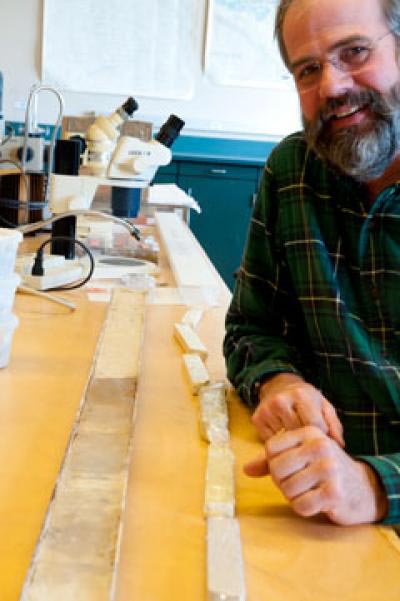
Phil Sexton, a former student of Norris' now at the Open University,UK, led the analysis of sediment cores collected off the South American coast.In the cores, evidence of the warm periods presented itself in bands of greysediment layered within otherwise pale-greenish mud. The grey sedimentcontained increased amounts of clay left after the calcareous shells ofmicroscopic organisms were dissolved on the sea floor. These clay-richintervals are consistent with ocean acidification episodes that would have beentriggered by large-scale releases of carbon dioxide. Large influxes of carbondioxide change the chemistry of seawater by producing greater amounts ofcarbonic acid in the oceans.
The authors concluded that a release of carbon dioxide from the deepoceans was a more likely cause of the hyperthermals than other triggeringevents that have been hypothesized. The regularity of the hyperthermals andrelatively warm ocean temperatures of the period makes them less likely to havebeen caused by events such as large melt-offs of methane hydrates, terrestrialburning of peat or even proposed cometary impacts. The hyperthermals could havebeen set in motion by a build-up of carbon dioxide in the deep oceans caused byslowing or stopping of circulation in ocean

No comments:
Post a Comment